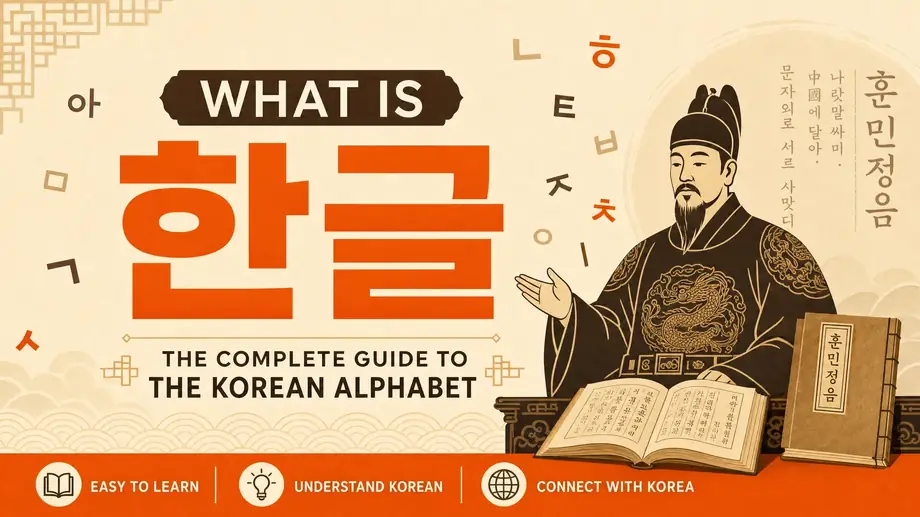
Have you ever wondered how Korean writing works? Unlike Chinese or Japanese, which require thousands of characters to master, Korean has its own unique alphabet called Hangul (한글) — and it was invented by a single king with one clear goal: to give ordinary people the power to read and write. Here's everything you need to know about one of the world's most fascinating writing systems.
📖 What is Hangul?
Hangul (한글) is the official writing system of Korea. It was created in 1443 by King Sejong the Great, the fourth king of the Joseon Dynasty. Unlike most writing systems in the world, which evolved gradually over centuries, Hangul was deliberately invented — designed from scratch with one clear purpose: to help ordinary people read and write.
Hangul consists of 14 consonants and 10 vowels — 24 basic letters in total. By combining these letters into syllable blocks, you can represent virtually every sound in the Korean language. Linguists consistently rank Hangul as one of the most logical and scientific writing systems ever created.
👑 King Sejong & the Creation of Hangul
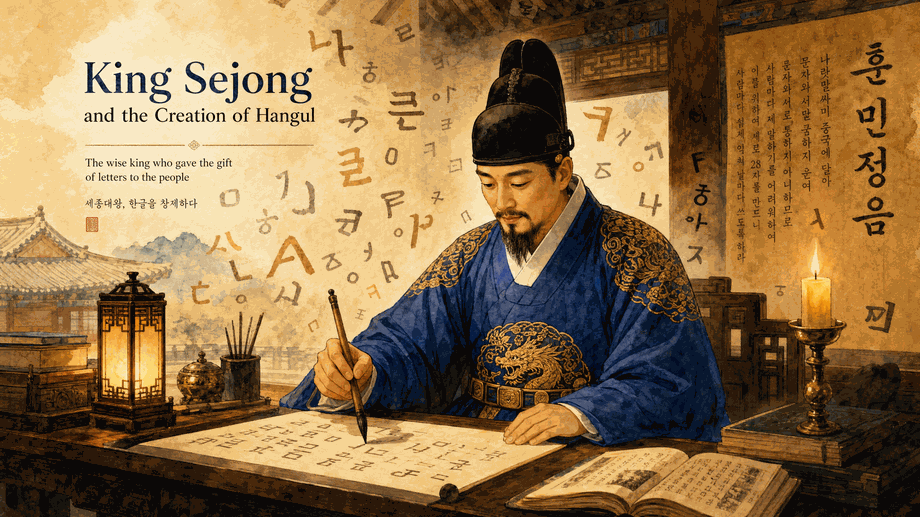
Before Hangul existed, Koreans used Chinese characters (Hanja) to write. The problem? Chinese characters were incredibly difficult to learn, and only the educated elite — mostly noblemen and scholars — could read and write. Ordinary people had no access to literacy.
King Sejong (1397–1450), widely regarded as the greatest ruler in Korean history, was deeply troubled by this. He believed that every person deserved the ability to express themselves in writing. So in 1443, together with scholars of the Hall of Worthies (Jiphyeonjeon), he created an entirely new writing system.
📜 King Sejong's Own Words (Hunminjeongeum, 1446)
"The language of our country is different from that of China and does not match the Chinese characters. Therefore, among the ignorant people, there are many who, having something they wish to put into words, are in the end unable to express themselves. I am greatly distressed because of this, and so I have made 28 new letters..."
📅 A Brief History of Hangul
King Sejong and the Hall of Worthies scholars created Hangul. At the time, the literacy rate among common people was extremely low due to the complexity of Chinese characters.
King Sejong officially announced Hangul through the Hunminjeongeum Haeryebon — a detailed document explaining the principles and usage of the new writing system.
The original Hunminjeongeum Haeryebon was discovered in Andong. This revealed the full scientific principles behind Hangul's creation. Now designated as National Treasure No. 70 of Korea.
The Haeryebon was inscribed in UNESCO's Memory of the World Register. Hangul remains the only writing system with a known creator and fully documented creation principles.
🔬 Why is Hangul Special?
Each consonant in Hangul was designed to mimic the shape of the vocal organ used to produce that sound. For example, ㄱ (g/k) represents the tongue root blocking the throat, ㄴ (n) represents the tongue tip touching the upper gum, and ㅁ (m) represents the shape of closed lips.
⚡
Quick to Learn
Most learners can read basic Korean within a few hours to a day of focused study.
🔬
Scientifically Designed
Letters mimic the shape of the mouth and throat when producing each sound.
📱
Digital-Friendly
Korean speakers type faster on mobile than speakers of most other languages.
📖 The Structure of Hangul
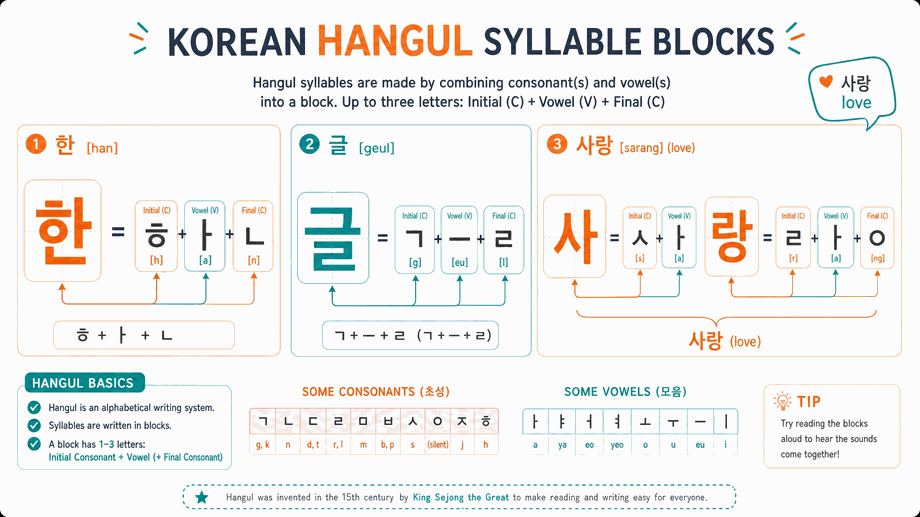
Hangul letters are not written individually in a line like the English alphabet. Instead, they are grouped into syllable blocks. Each block represents one syllable and contains at least one consonant and one vowel.
✅ Syllable Block Examples
글 (geul) = ㄱ (g) + ㅡ (eu) + ㄹ (l)
사랑 (sarang) = 사 (sa) + 랑 (rang) = love
💡 Rian's Note
After years of teaching both Korean and English, I can confidently say: Hangul is one of the easiest writing systems to pick up. Most of my students can read basic Korean within a few hours of focused practice. The key is understanding the structure — once you see the logic behind how consonants and vowels combine into syllable blocks, everything clicks. You don't need to memorize hundreds of characters like in Chinese or Japanese. Just 24 letters, and you're reading Korean.
🔗 Continue Learning
📚 Korean Basics Series
- Step 1: What is Hangul? — You are here ✅
- Step 2: Korean Vowels — A Complete Beginner's Guide
- Step 3: Korean Consonants — All 19 Letters Explained
- Step 4: How to Build Korean Syllables (Coming Soon)
- Step 5: Your First Korean Words (Coming Soon)