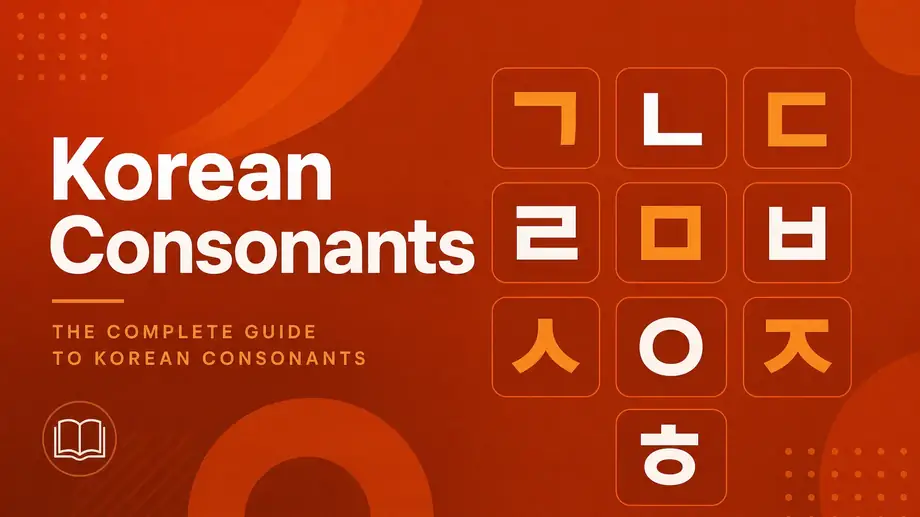
Korean has 14 basic consonants and 5 double (tense) consonants — 19 total. Each consonant has an official name in Korean, just like how English has "ay" for A, "bee" for B. Learning these names is essential because Koreans use them when spelling words out loud. Click any consonant to hear its name! 🔊
💡 Why Learn the Names?
When a Korean person spells their name or a word, they say the consonant names out loud — just like saying 'K-I-M' in English. For example, 김 (Kim) = 기역 + 이 + 미음. Knowing these names makes you sound like a real Korean learner!
📖 How to Read This Guide
Each card below shows:
- The consonant character (click to hear its name)
- Official Korean name (e.g., 기역, 니은)
- Romanization of the name [in brackets]
- Sound description — how it sounds in English
- Example word button — click to hear a real Korean word
📝 Rian's Note
The sound of a consonant changes depending on its position in a syllable (initial vs. final). For example, ㄱ sounds like 'g' at the start of a syllable, but like 'k' at the end. Don't worry — this becomes natural with practice!
🔤 The 14 Basic Consonants (기본 자음)
Click the large character to hear its name, or the word button to hear an example:
🎯 Aspirated vs. Plain Consonants
Korean has pairs of consonants that differ in 'breathiness'. ㄱ (g/k) vs ㅋ (k with a puff of air). ㄷ (d/t) vs ㅌ (t with air). ㅂ (b/p) vs ㅍ (p with air). ㅈ (j) vs ㅊ (ch with air). Hold your hand in front of your mouth — aspirated consonants make it move!
⚡ The 5 Double (Tense) Consonants (쌍자음)
Double consonants are written by doubling a basic consonant. They produce a tense, tighter sound — like you're holding your breath slightly before releasing. They always appear at the beginning of a syllable.
🔊 How to Pronounce Tense Consonants
Tense consonants (쌍자음) sound like the consonant is 'held' before being released. Try saying 'sky' — the 'k' in 'sky' is closer to ㄲ than the 'k' in 'key'. No puff of air, just a tight, clear sound. Practice: 꿈 (dream), 딸기 (strawberry), 빵 (bread)!
💨 The 4 Aspirated Consonants (격음)
Aspirated consonants are produced with a strong puff of air — like blowing out a candle as you speak. Each one is the "breathy" version of a basic consonant. You can feel the air on your hand when you say them correctly!
💡 Rian's Tip: The Paper Test
Hold a thin piece of paper in front of your mouth. When you say ㅋ, ㅌ, ㅍ, or ㅊ correctly, the paper should move. For plain consonants (ㄱ, ㄷ, ㅂ, ㅈ), the paper stays still. This is the fastest way to feel the difference between aspirated and plain consonants!
📊 Complete Consonant Reference Table
| Char | Name (Korean) | Romanization | Sound | Type |
|---|---|---|---|---|
| ㄱ | 기역 | gi-yeok | g / k | Plain |
| ㄴ | 니은 | ni-eun | n | Plain |
| ㄷ | 디귿 | di-geut | d / t | Plain |
| ㄹ | 리을 | ri-eul | r / l | Plain |
| ㅁ | 미음 | mi-eum | m | Plain |
| ㅂ | 비읍 | bi-eup | b / p | Plain |
| ㅅ | 시옷 | si-ot | s / sh | Plain |
| ㅇ | 이응 | i-eung | silent / ng | Plain |
| ㅈ | 지읒 | ji-eut | j / ch | Plain |
| ㅊ | 치읓 | chi-eut | ch (aspirated) | Aspirated |
| ㅋ | 키읔 | ki-euk | k (aspirated) | Aspirated |
| ㅌ | 티읕 | ti-eut | t (aspirated) | Aspirated |
| ㅍ | 피읖 | pi-eup | p (aspirated) | Aspirated |
| ㅎ | 히읗 | hi-eut | h | Plain |
| ㄲ | 쌍기역 | ssang-gi-yeok | tense k | Tense (Double) |
| ㄸ | 쌍디귿 | ssang-di-geut | tense t | Tense (Double) |
| ㅃ | 쌍비읍 | ssang-bi-eup | tense p | Tense (Double) |
| ㅆ | 쌍시옷 | ssang-si-ot | tense s | Tense (Double) |
| ㅉ | 쌍지읒 | ssang-ji-eut | tense j | Tense (Double) |
🚀 Rian's Expert Tip
The fastest way to memorize consonant names is to use them when you spell Korean words out loud. Try spelling your name in Korean! For example, if your name is 'Kim': ㄱ(기역) + ㅣ(이) + ㅁ(미음) = 김. Practice spelling 3 Korean words every day and you'll have all 19 names memorized within a week.