You've made it through consonants, vowels, and syllable blocks. You can look at a Korean word and start to piece it together. But then you hit something like 닭 (chicken) and your brain short-circuits — why does it sound like dak instead of dalg? Welcome to 받침 (batchim), the final consonant that sits at the bottom of a Korean syllable block. This is the last major piece of the Hangul reading puzzle, and once you understand it, you'll be able to read Korean with genuine accuracy.
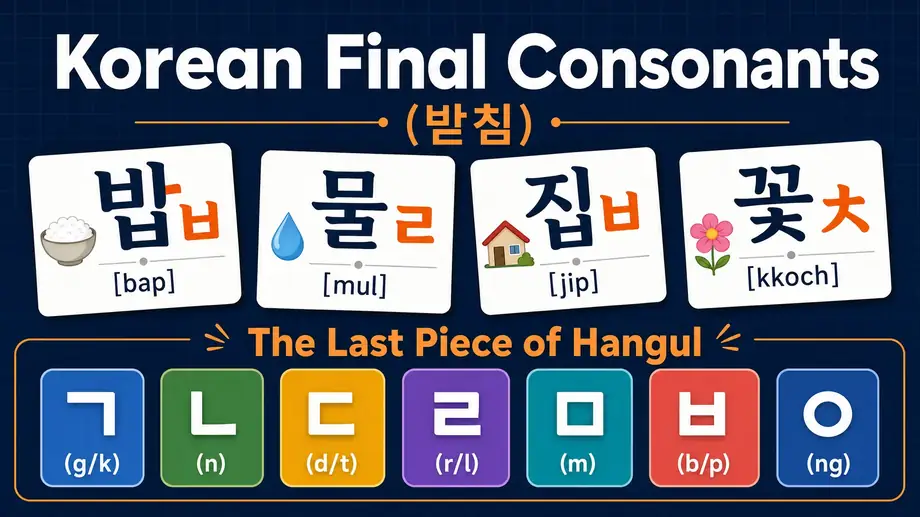
The good news: Korean linguists designed 받침 with remarkable consistency. There are only 7 representative sounds that any final consonant can produce, regardless of which letter is written. That's the genius of Hangul — it's not arbitrary. Once you internalize these 7 sounds, the system clicks into place.
💡 Rian's Tip
받침 is the single most common reason learners mispronounce Korean words. Don't skip this step. 20 minutes here will save you months of bad habits.
📦 What is 받침 (Batchim)?
In Korean, every syllable block follows the structure: Initial Consonant (초성) + Vowel (중성) + Final Consonant (종성). The final consonant is called 받침, which literally means "support" or "base." Not every syllable has a 받침 — 가 (ga), 나 (na), 아 (a) have none. But when one is present, it fundamentally changes how the syllable sounds.
Syllable Block Structure
가
ga — no 받침
강
gang — ㅇ 받침
갑
gap — ㅂ 받침
🔢 The 7 Representative Sounds of 받침
Here is the core rule: all Korean final consonants reduce to one of 7 sounds. Even if you see a double consonant (겹받침) or a consonant you wouldn't expect, it will always produce one of these sounds. This is called the 대표음 (representative sound) rule.
ㄱ sound — [k]
Letters: ㄱ, ㄲ, ㅋ, ㄳ, ㄺ
Example: 국 (guk, soup), 닭 (dak, chicken)
ㄴ sound — [n]
Letters: ㄴ, ㄵ, ㄶ
Example: 산 (san, mountain), 눈 (nun, snow/eye)
ㄷ sound — [t]
Letters: ㄷ, ㅅ, ㅆ, ㅈ, ㅊ, ㅌ, ㅎ
Example: 밭 (bat, field), 꽃 (kkot, flower)
ㄹ sound — [l]
Letters: ㄹ, ㄼ, ㄽ, ㄾ, ㅀ
Example: 말 (mal, horse/word), 물 (mul, water)
ㅁ sound — [m]
Letters: ㅁ, ㄻ, ㄿ
Example: 밥 (bap, rice/meal), 봄 (bom, spring)
ㅂ sound — [p]
Letters: ㅂ, ㅍ, ㄼ, ㄿ, ㅄ
Example: 입 (ip, mouth), 앞 (ap, front)
ㅇ sound — [ng]
Letters: ㅇ only
Example: 강 (gang, river), 방 (bang, room)
🔗 연음 (Liaison) — When 받침 Moves to the Next Syllable
Here's where Korean pronunciation gets interesting. When a 받침 is followed by a syllable that starts with ㅇ (which is silent at the beginning of a syllable), the 받침 moves over to become the initial consonant of the next syllable. This is called 연음 (yeon-eum), or liaison.
연음 Examples — Click to hear:
I eat / I'm eating
I read / I'm reading
Korean language
💡 Rian's Tip — The Liaison Rule in One Sentence
If a 받침 is followed by a syllable starting with ㅇ, the 받침 slides over and becomes the initial consonant of that next syllable. Your mouth naturally wants to do this — Korean is designed to flow smoothly.
🎯 Practice: Read These Words Aloud
Test yourself. Look at each word, try to read it, then click 🔊 to check your pronunciation. Focus on the 받침 sound at the end of each syllable.
밥
bap
rice / meal
물
mul
water
집
jip
house / home
책
chaek
book
꽃
kkot
flower
닭
dak
chicken
🎓 You Can Now Read Korean
Let that sink in. You've completed the five foundational steps of Hangul:
Step 1: Understanding what Hangul is and why it works. Step 2: Learning all 19 consonants. Step 3: Learning all 21 vowels. Step 4: Building syllable blocks. Step 5: Mastering 받침 and liaison rules.
You can now look at any Korean word and produce a sound. It may not be perfect yet — that takes practice — but the system is in your head. That's the foundation. Everything else — vocabulary, grammar, conversation — builds on this.
💡 Rian's Tip — What's Next
Now that you have the theory, you need to train your eyes and mouth to work together automatically. Head to the Hangul Practice App (Step 6) — it combines reading, listening, speaking, and writing in one session. 30 minutes there is worth more than 3 hours of passive study.
📌 Korean Basics Series