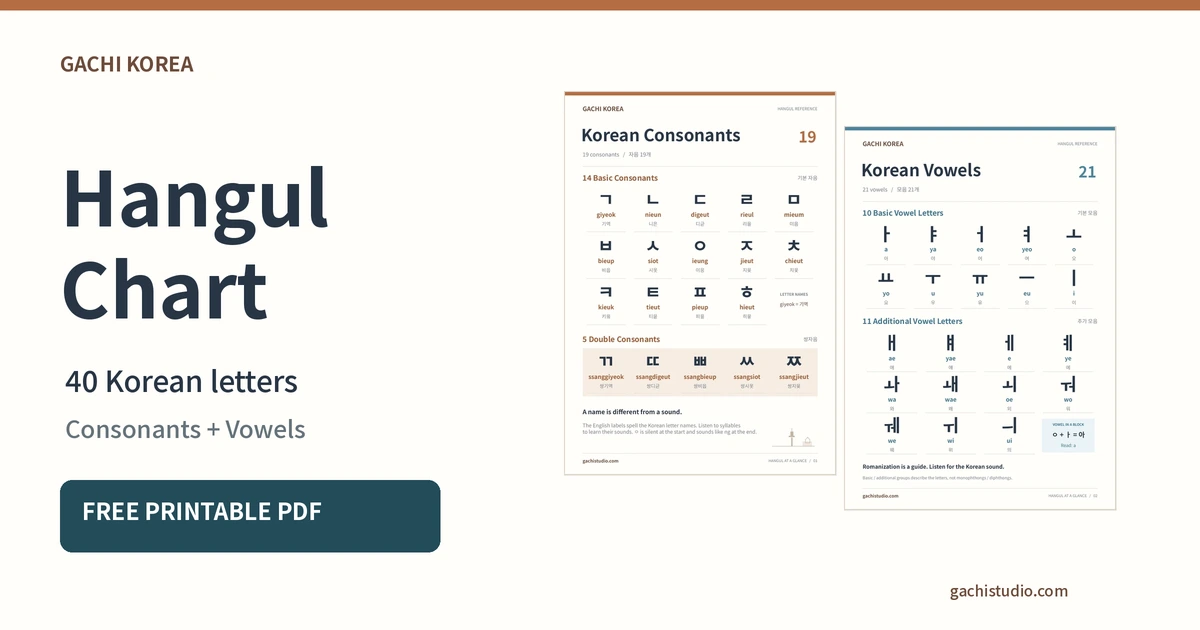
A Hangul chart gives you a map of the Korean alphabet: consonants on one side, vowels on the other. The useful next step is knowing what to do with that map. Should you memorize every label? Why do some charts have 24 letters while others have 40? And how does ㄱ become part of a word?
This guide helps you use Gachi Korea’s free printable Korean alphabet charts to recognize letters, compare similar shapes and begin building syllables. You can start with just a few letters and a notebook.
Get your free Hangul chart PDF
Two A4 portrait pages: 19 consonants and 21 vowels, with Korean labels and English romanization. No sign-up needed.
Preview & Download Free Charts →A separate stroke-order guide is also available on the download page.
Does Hangul have 24 or 40 letters?
You will see both numbers because they count different sets. The 24 basic letters are 14 consonants and 10 vowels. Adding five double consonants and 11 additional vowel letters gives you the 40 letters shown in our reference charts.
| Set | Letters | Count |
|---|---|---|
| Basic consonants | ㄱ ㄴ ㄷ ㄹ ㅁ ㅂ ㅅ ㅇ ㅈ ㅊ ㅋ ㅌ ㅍ ㅎ | 14 |
| Double consonants | ㄲ ㄸ ㅃ ㅆ ㅉ | 5 |
| Basic vowel letters | ㅏ ㅑ ㅓ ㅕ ㅗ ㅛ ㅜ ㅠ ㅡ ㅣ | 10 |
| Additional vowel letters | ㅐ ㅒ ㅔ ㅖ ㅘ ㅙ ㅚ ㅝ ㅞ ㅟ ㅢ | 11 |
These are letters, not 40 words or 40 syllables. Korean combines letters into syllable blocks, such as 가 and 나. The National Institute of Korean Language describes this basic-letter and compound-letter distinction in its explanation of Hangul’s structure.
You do not need to memorize the whole chart in one session. Treat it as a reference you return to while reading and writing.
Why do Hangul letters look like this?
The shapes become more interesting when you know the ideas behind them. The basic consonant designs relate to speech organs, while the original vowel designs also draw on a philosophical view of the world.
Five consonant designs: look inside the mouth
The National Institute of Korean Language explains these five starting shapes:
| Letter | Design origin | A useful visual reminder |
|---|---|---|
| ㄱ | The back of the tongue contacting the soft palate. | Notice the bent shape. |
| ㄴ | The tongue tip meeting the gum just behind the upper teeth. | Notice the upward contact at one end. |
| ㅁ | The upper and lower lips closed together. | Think of a closed outline. |
| ㅅ | The teeth. | Notice the pointed shape. |
| ㅇ | The throat opening. | Notice the round outline. |
Other consonants develop from these starting designs. For example, ㄱ and ㅋ share a family shape, while ㄴ, ㄷ and ㅌ are visibly related. Use the relationships to organize your chart study, and listen to Korean examples to learn the sound differences.
These historical design explanations come from the Institute’s guide to consonant formation. They explain the origin of the shapes; a printed letter is not an anatomical diagram.
Vowel designs: sky, earth and a person
The original system used three elements:
A round dot
A flat horizontal line
An upright vertical line
Historically, combining the dot with the horizontal or vertical line produced other vowels. Over time, the dot in letters such as ㅏ and ㅗ became the short stroke you see today. Its position helps explain the visual contrasts between ㅏ / ㅓ and ㅗ / ㅜ.
The historical letter ㆍ is not an extra modern vowel to add to your 21-letter chart. We show it here to explain the design’s origin. See the Institute’s vowel formation guide for the historical explanation.
Look for shape families and stroke positions, then check yourself without the chart. The story gives you a connection to remember; listening and practice help you use the letters.
How to read the Korean consonant chart
The consonant chart shows a large letter, its romanized name and its Korean name. For example, ㄱ is 기역, written giyeok in romanization. That label tells you the letter’s name; it does not tell you to pronounce every ㄱ as the entire word “giyeok.”
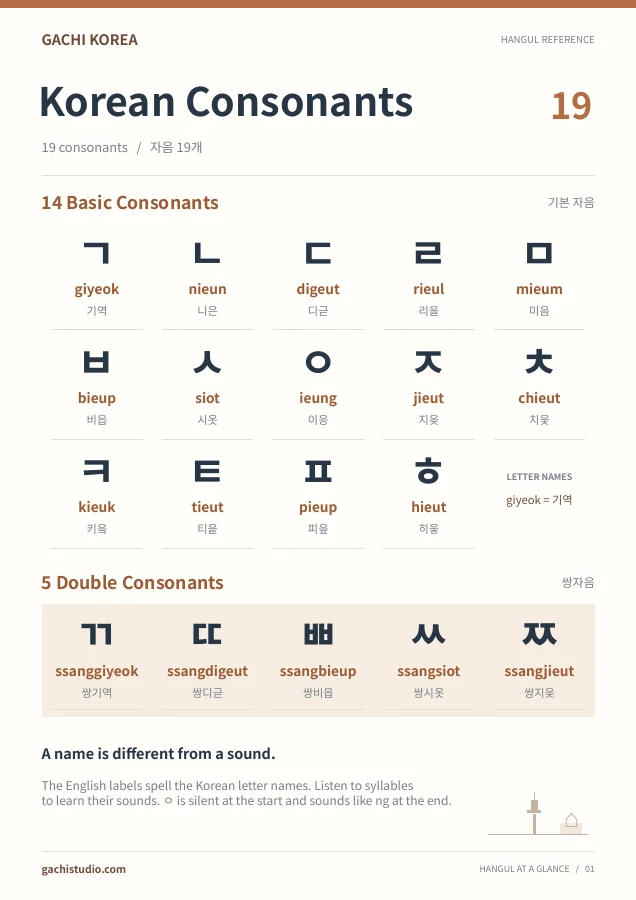
Begin by finding ㄱ, ㄴ and ㅁ. Say or listen to their names, point to each shape, then cover the names and find the letters again. For the full set of names, use our Korean consonant song and learning guide.
Watch for ㅇ. At the beginning of a syllable it has no sound, as in 아. At the end of a syllable it represents the “ng” sound, as in 강. The same shape can therefore play different roles depending on its position.
The five double consonants belong in the complete chart, but you can study them after becoming familiar with the basic forms. Recognizing ㄲ as related to ㄱ helps you locate it; learning its tense sound also requires listening.
How to use the Korean vowel chart
Our vowel chart separates 10 basic written vowels from 11 additional written vowels. The English labels are romanization guides, such as a, eo and eu. They are not instructions to read the letters as English alphabet names.
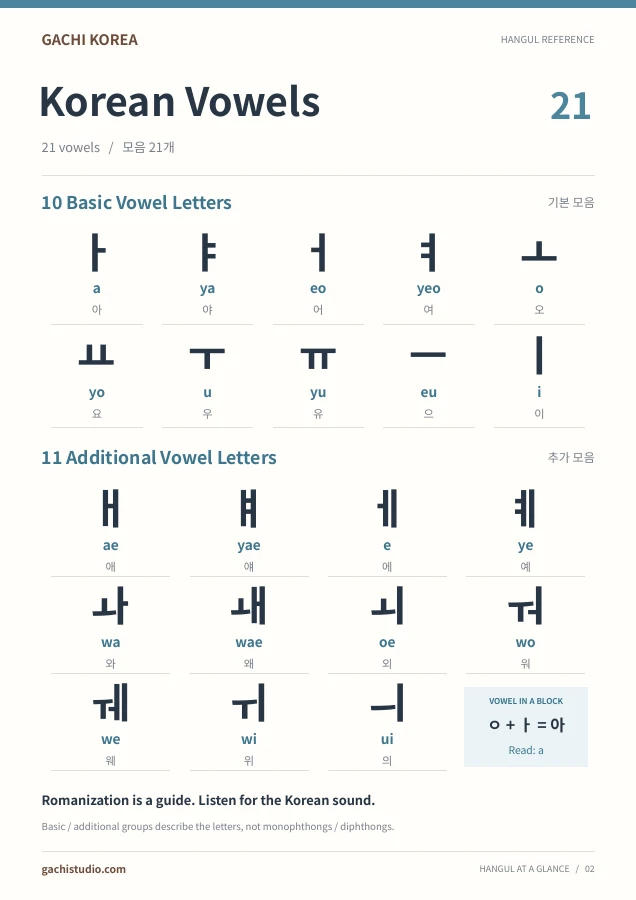
Try studying a small contrast rather than reading every label in order:
| Compare | What to notice | Chart labels |
|---|---|---|
| ㅏ / ㅓ | The short stroke points right / left. | a / eo |
| ㅗ / ㅜ | The short stroke points up / down. | o / u |
| ㅡ / ㅣ | The main line is horizontal / vertical. | eu / i |
| ㅏ / ㅑ | One short stroke / two short strokes. | a / ya |
For a first session, choose ㅏ, ㅓ, ㅗ, ㅜ, ㅡ and ㅣ. Then add ㅑ, ㅕ, ㅛ and ㅠ. This is a suggested study sequence; the chart still contains all ten basic vowel letters.
Next, explore ㅐ, ㅒ, ㅔ and ㅖ, followed by ㅘ, ㅙ, ㅚ, ㅝ, ㅞ, ㅟ and ㅢ. “Additional” describes the written letters here. It does not mean all eleven are pronounced as diphthongs. For sound examples, open our Korean vowel guide with listening practice.
Turn individual letters into your first syllables
Once you recognize a few letters, put them to work:
- ㄱ + ㅏ = 가 — ga
- ㄴ + ㅏ = 나 — na
- ㅁ + ㅜ = 무 — mu
- ㅇ + ㅏ = 아 — a
Notice the layout. With ㅏ, the vowel goes beside the consonant. With ㅜ, it goes underneath. The silent initial ㅇ in 아 fills the consonant position so that the vowel can form a complete syllable block.
Use Let’s Build Hangul to combine letters and hear examples. You are applying the chart now, rather than only reciting it.
A five-minute Hangul chart study routine
Here is one manageable session using ㄱ, ㄴ, ㅁ and ㅏ. The five minutes are a suggested practice length, not a promise to master Hangul.
- Look — one minute. Find each letter on the chart. Notice its shape before reading the label.
- Listen and point — one minute. Use the consonant song or vowel audio. Pause and point to the letter you hear.
- Recall — one minute. Cover the chart and write the four shapes on blank paper. If writing is still difficult, point to each letter in a shuffled list instead.
- Build — one minute. Make 가, 나 and 마. Say them with a Korean audio model.
- Check — one minute. Compare your attempt with the chart. Choose one thing to revisit in your next session.
Tomorrow, briefly check these letters again before adding more. If you mix up ㅏ and ㅓ, spend your next session on that pair instead of rushing through the entire page. The goal is to use the letters independently, with the chart available when you need it.
Do I need stroke order too?
If you are beginning to write, a model showing where to start can help you follow the letter’s shape. Our separate free Hangul stroke-order PDF uses light gray for upcoming strokes, dark brown for completed strokes, and orange or blue for the current stroke.
Start with the reference chart to identify a letter, then check that letter in the writing guide. You can get both free resources here or watch the animated strokes in the practice app. Some handwriting styles join or separate strokes differently; our guide follows the Gachi writing model.
A quick check before you close the chart
Try these without looking at the tables above:
- Which set contains ㄲ: basic consonants or double consonants?
- Which vowel has a short stroke pointing downward: ㅗ or ㅜ?
- What do ㄴ and ㅏ form together?
- Does “giyeok” name a letter or a whole Korean word you should say whenever ㄱ appears?
Show the answers
1. Double consonants. 2. ㅜ. 3. 나. 4. It is the name of ㄱ; it is not the sound to substitute every time you read that consonant.
Keep learning with Gachi Korea
Ready to practise on paper?
The free charts give you a reference. The separate paid Korean Consonant Writing Workbook adds guided tracing, copying and recall practice.
See the Workbook on Etsy ↗See the listing for current pricing, availability and product previews.
For more free lessons, songs and writing demonstrations, watch Gachi Korea on YouTube. Begin with the consonant-name song below, keeping your chart beside you.
Your next step: Download the free printable Hangul charts, choose a few letters and try the short routine above.
References and chart notes
The letter inventory and basic/compound distinction follow the National Institute of Korean Language’s Hangul structure overview. Korean letter names can be checked in its letter-name guidance. The design-origin sections also draw on its consonant and vowel explanations. The printable charts, study sequence and practice routine are Gachi Korea resources. Romanization supports identification; use Korean audio when learning pronunciation.