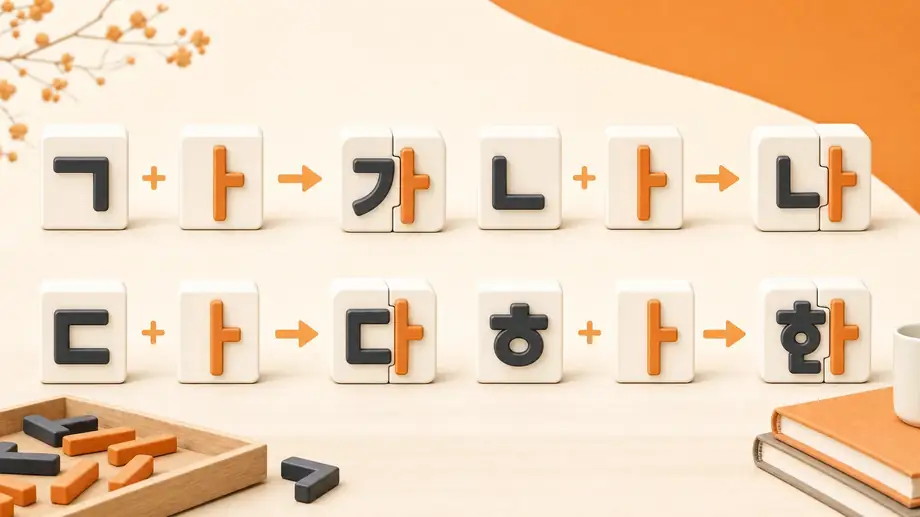
This is where Korean gets beautiful. Unlike Chinese characters that you memorize one by one, Korean syllables follow a logical, predictable system. Once you understand the 3 rules of syllable blocks, you can read any Korean word — even ones you've never seen before. Click 🔊 to hear each example!
🧱 Rule 1: Every Syllable is a Block
Every Korean syllable is written inside an invisible square block. A block always contains:
- Initial consonant (초성) — always required (use silent ㅇ if the syllable starts with a vowel)
- Vowel (중성) — always required
- Final consonant (받침) — optional, but common
💡 Rian's Tip
Think of each syllable block like a Lego piece. You snap a consonant and a vowel together to make one block. Then you stack blocks to make words. 가방 (bag) = 가 block + 방 block. Simple!
📐 Rule 2: Vertical vs Horizontal Vowels Change the Layout
The vowel's shape determines where the consonant goes. Click each example to hear it:
↓ Horizontal vowels — consonant goes ON TOP:
📝 Memory Rule
Vertical vowel (ㅏ ㅓ ㅣ etc.) = consonant on the LEFT. Horizontal vowel (ㅗ ㅜ ㅡ etc.) = consonant on TOP. The vowel's direction tells you where the consonant lives!
🏠 Rule 3: The Final Consonant (받침 Batchim)
Many Korean syllables end with a consonant called 받침 (batchim). It sits at the bottom of the block, below the vowel. Click to hear how batchim changes the sound:
🎯 Rian's Note
When batchim is followed by a vowel in the next syllable, it 'links' to that vowel. This is called 연음 (yeon-eum). Example: 한국어 = han-gu-geo (not han-guk-eo). This is why Korean sounds so smooth and flowing!
🔨 Practice: Build These Words!
Now try reading these common words. Click each one to check your pronunciation:
🚀 You're Ready!
Congratulations! You now understand the complete Hangul system: consonants + vowels + syllable blocks. With practice, you'll be reading Korean in just a few days. Next up: learn common Korean greetings and put your Hangul skills to use!