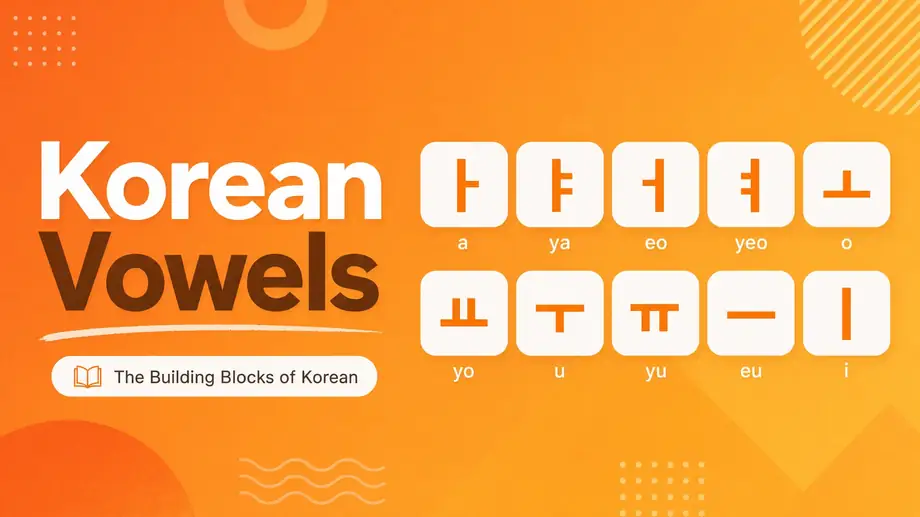
Korean vowels are the foundation of Hangul. Unlike English vowels that are inconsistent (think "a" in "cat" vs "cake"), Korean vowels are perfectly consistent — each vowel always sounds the same, every time. This makes Korean surprisingly easy to read once you know the system. Click the 🔊 buttons below to hear each vowel!
🎵 The 10 Basic Korean Vowels — Click to Hear!
Here are all 10 basic vowels. Each card shows the vowel, its romanization, and an example word. Click 🔊 듣기 to hear the pronunciation:
💡 Rian's Tip
The two trickiest vowels for English speakers are ㅓ (eo) and ㅡ (eu). For ㅓ, think of the 'u' in 'cup'. For ㅡ, keep your mouth flat and make an 'uh' sound — no lip rounding! Practice these two first and the rest will feel easy.
📐 Vertical vs Horizontal Vowels
One of the most important things about Korean vowels is their shape, because it determines how you build syllable blocks:
- Vertical vowels (ㅏ ㅑ ㅓ ㅕ ㅣ): the consonant goes on the LEFT, vowel on the RIGHT → 가 나 다
- Horizontal vowels (ㅗ ㅛ ㅜ ㅠ ㅡ): the consonant goes on TOP, vowel on the BOTTOM → 고 노 도
📝 Quick Memory Trick
Vertical vowels have a tall vertical line — so the consonant sits beside them (left). Horizontal vowels have a wide horizontal line — so the consonant sits above them (top). The vowel's shape tells you exactly where to put the consonant!
🔊 Practice Words — Click to Listen!
Here are common Korean words using the basic vowels. Click the orange button to hear native pronunciation:
🌊 The 11 Compound Vowels (이중모음)
Beyond the 10 basic vowels, Korean has 11 compound vowels formed by combining basic vowels. The most important ones to know are:
🎯 Next Step
Once you know all vowels, combine them with consonants to build syllable blocks! Check out our Korean Syllable Blocks guide to see how everything fits together.