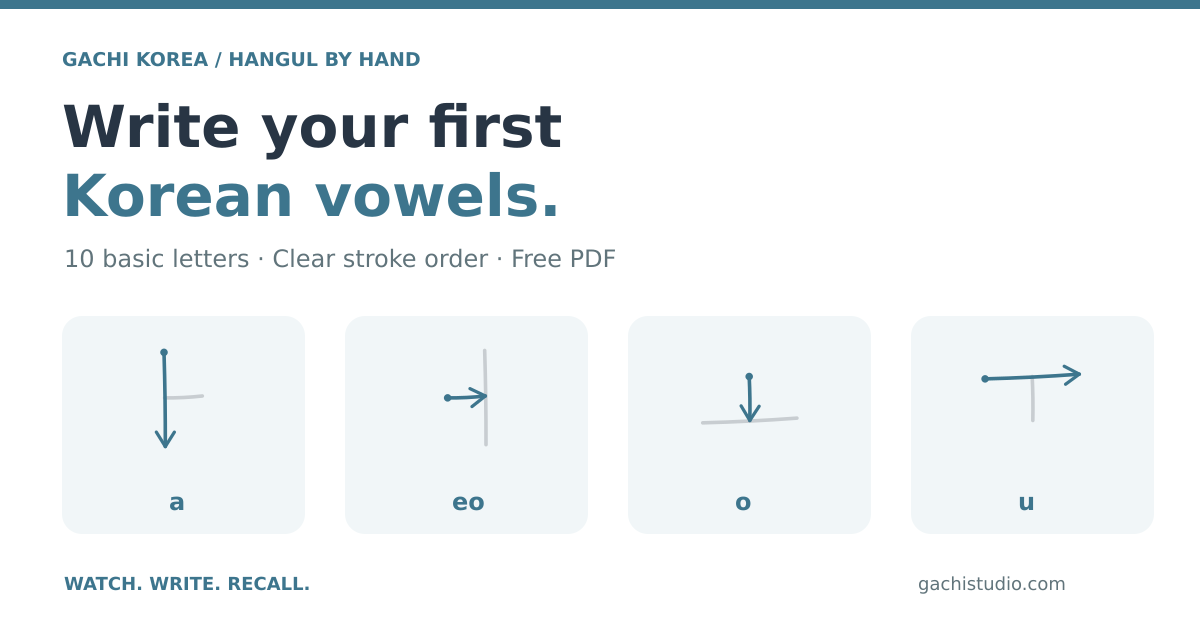
Your eyes may recognise a Korean vowel before your hand knows where to begin. That gap becomes obvious with ㅏ and ㅓ: their shapes look like mirror images, but their pen movements do not start the same way.
This beginner guide turns the 10 basic Korean vowel letters into manageable writing routes. You will follow a video, compare four easily confused shapes, and check what you can write without the model.
Notice three things: the starting point, the direction of each stroke, and where you lift your pen.
01 · WATCH & TRYLet your pencil join the lesson
Have a pencil and paper ready. For each vowel, listen, watch, then write during Your Turn. Pause whenever you need more time. Afterwards, cover the example and try once more.
Prefer a sound-focused introduction? Start with our 10 basic Korean vowels song, then return here for the pen movements.
02 · NOTICE THE DIFFERENCEMirror the shape, not the starting stroke
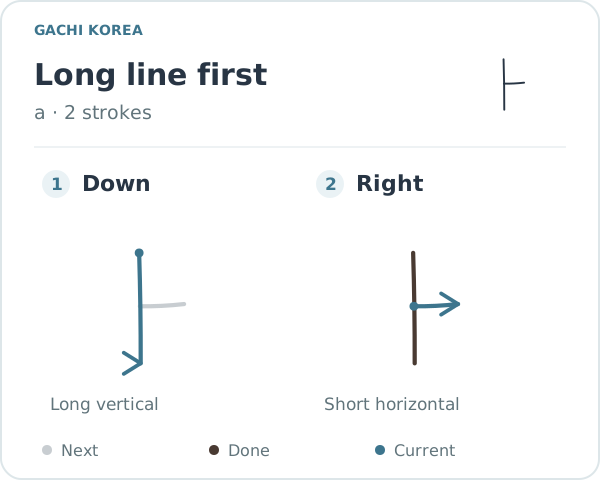
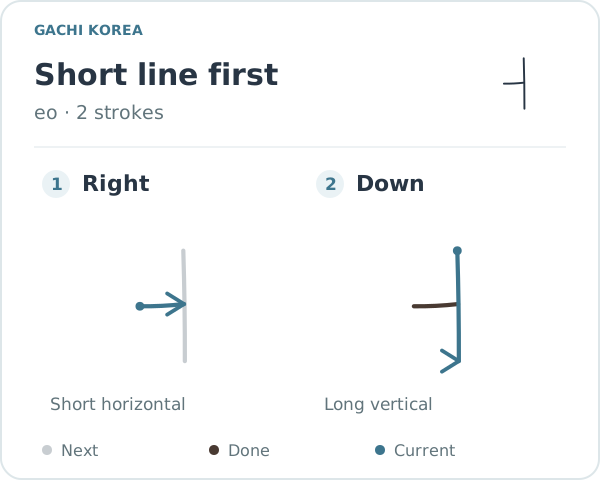
In our writing model, ㅏ starts with the long vertical line. For ㅓ, the short horizontal line comes first, moving from left to right towards the stem. Both letters take two pen strokes.
Now compare ㅗ and ㅜ. The upward-pointing short line in ㅗ is still drawn downward, before the long horizontal. In ㅜ, write the long horizontal first, then draw the short line down.
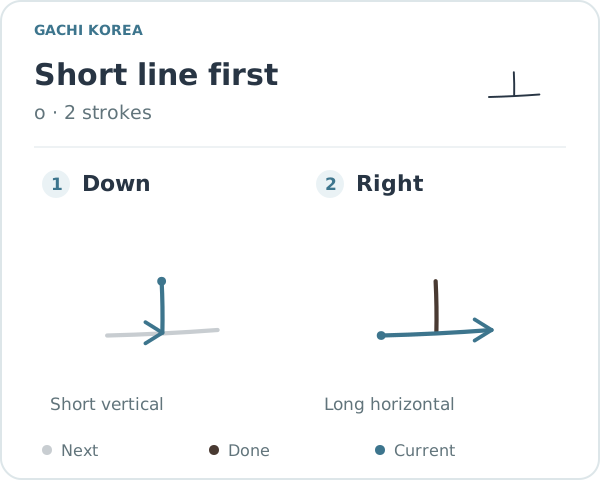
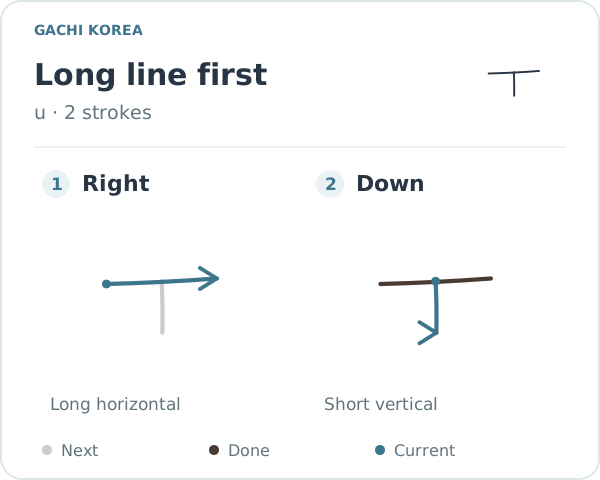
Where a line points is different from how your pen moves. That distinction helps you read an arrow instead of guessing a movement from the finished letter. In the diagrams, gray shows the remaining shape, dark brown is complete, and blue is the current stroke.
A small stroke with a long history
The short strokes have a historical connection to a dot. Early vowel designs combined a dot representing heaven with lines representing earth and a person. Its position helps explain the relationships among ㅏ, ㅓ, ㅗ and ㅜ. The National Institute of Korean Language explains these origins. Our modern diagrams show the writing movements.
03 · KEEP A REFERENCETen vowel letters, a few connected patterns
Begin with ㅏ, ㅓ, ㅗ, ㅜ, ㅡ and ㅣ. Then add a second short stroke to the appropriate shapes to form ㅑ, ㅕ, ㅛ and ㅠ. These four y-glide letters are part of the conventional ten basic written vowels.
| Vowel | Strokes | Follow this route |
|---|---|---|
| ㅏa | 2 | 1. Long vertical down. 2. Short horizontal right. |
| ㅓeo | 2 | 1. Short horizontal right. 2. Long vertical down. |
| ㅗo | 2 | 1. Short vertical down. 2. Long horizontal right. |
| ㅜu | 2 | 1. Long horizontal right. 2. Short vertical down. |
| ㅡeu | 1 | One horizontal from left to right. |
| ㅣi | 1 | One vertical from top to bottom. |
| ㅑya | 3 | 1. Long vertical down. 2–3. Upper, then lower short horizontal right. |
| ㅕyeo | 3 | 1–2. Upper, then lower short horizontal right. 3. Long vertical down. |
| ㅛyo | 3 | 1–2. Left, then right short vertical down. 3. Long horizontal right. |
| ㅠyu | 3 | 1. Long horizontal right. 2–3. Left, then right short vertical down. |
The labels are romanization aids. “eo” does not mean two separate syllables, and “eu” is not the English letter names E–U. Use the recording or our vowel guide with listening practice for sound models. Handwriting styles can vary; this table follows the model used in our lesson and free guide.
04 · MAKE IT YOURSFive minutes that go beyond copying
A neat copy tells you that you can follow a model. A recognisable attempt with the model hidden tells you something else: you can bring the shape back yourself. Include both.
- Notice — one minute. Choose a pair, such as ㅏ/ㅓ. Watch where each stroke starts before moving your pencil.
- Copy — one minute. Write each letter slowly with the model visible. Say the movement quietly: “down, right” or “right, down.”
- Recall — one minute. Cover the model and write both letters. Leave your attempt visible before checking.
- Compare — one minute. Check one feature: starting stroke, short-line direction or number of short strokes. Correct it once.
- Use — one minute. Put a vowel into a syllable block, then schedule a brief check tomorrow.
For that last step, add silent initial ㅇ:
The first ㅇ fills the initial position without adding a sound. A vertical vowel sits beside it; a horizontal vowel goes underneath it. Try 우유 (“milk”): two blocks containing ㅜ and ㅠ. Explore more examples in Build Hangul.
Why include handwriting at all?
Wiley and Rapp’s 2021 study of letter learning in 42 adults compared handwriting, typing and visual practice. Handwriting produced faster learning and greater transfer to other tasks. That supports including active pen practice alongside watching. The study did not test this Hangul lesson, its colours or this five-minute routine.
05 · CHECK BEFORE YOU FINISHCan you explain your first stroke?
Without checking the table, try three small challenges:
- Write ㅓ. Which line did you start with?
- Write ㅗ and ㅜ. Which one begins with the long horizontal?
- Change ㅏ into ㅑ. What changes in the shape and stroke count?
Open the answers after trying
1. Start ㅓ with the short horizontal, moving right; draw the long vertical second.
2. ㅜ begins with the long horizontal. ㅗ begins with the short vertical.
3. ㅑ has two short right-facing strokes. In this model, its stroke count increases from two to three.
Tomorrow, try the same three prompts before opening the guide. If one pair still causes trouble, keep working with that pair before adding more.
Keep the free PDF beside your paper
The five-page Hangul Stroke Order PDF includes the ten basic vowels, basic and double consonants, and additional vowel letters. A separate two-page reference pack shows all 19 consonants and 21 vowels.
Print the basic-vowel stroke page for this lesson. Cover a row to test yourself, then uncover it to check the movement.
A4 portrait · English guidance · No sign-up required
Continue with a model: rewatch the vowel writing lesson, or pair it with our 14-consonant writing video. Find both in KR100: Hangul from Zero.
Sources & writing-model notes
Letter inventory and the silent initial ㅇ: National Institute of Korean Language — Hangul structure. Historical vowel designs: vowel formation. Handwriting research: Wiley & Rapp (2021), The Effects of Handwriting Experience on Literacy Learning. The diagrams, pen-movement explanations and practice routine are Gachi Korea teaching materials. “Basic vowels” refers to the written-letter set; this lesson does not cover all 21 modern vowel letters.