I'll be honest — I used to run with whatever was on my Spotify Discover Weekly. Sometimes it worked, sometimes I'd end up shuffling through songs mid-run, completely killing my momentum. Then I found Daylody's running playlist, and something clicked. Not just motivationally, but physically. I was running farther without realizing it. Turns out, there's actual science behind why.
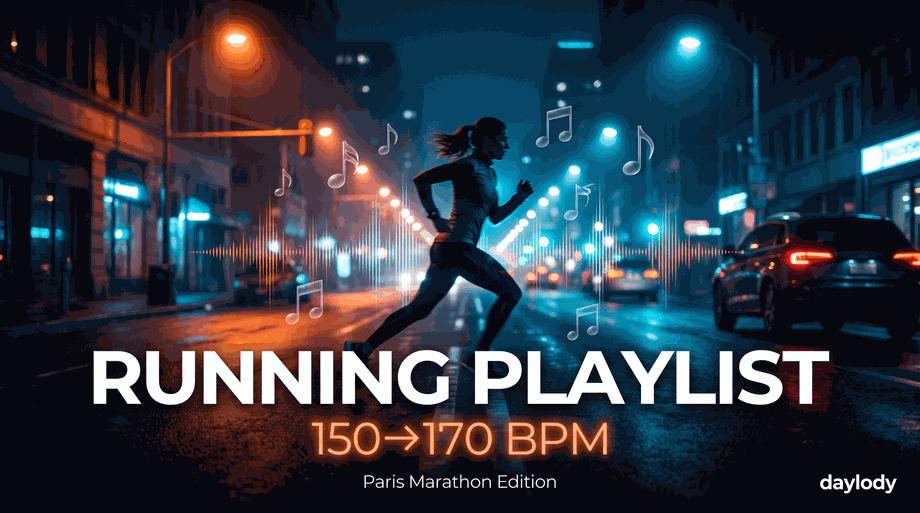
This playlist — built specifically for the Paris Marathon full course — runs 2 hours and 21 minutes at a carefully engineered 168 BPM. No ads. No interruptions. Just a continuous groove designed to keep your legs moving and your mind from quitting.
🔬 Why BPM Actually Matters for Running
Music tempo and running cadence are more connected than most people realize. Research published in the Journal of Sport & Exercise Psychology found that music with a tempo matching a runner's natural cadence can reduce perceived exertion by up to 12% — meaning you feel like you're working less, even when you're not. Your brain literally syncs your footstrike to the beat, a phenomenon called auditory-motor coupling.
Elite runners typically aim for a cadence of 160–180 steps per minute. That's exactly the sweet spot this playlist targets. At 168 BPM, you're in the zone where your stride becomes more efficient, your ground contact time shortens, and your risk of overstriding drops significantly.
💡 Rian's Tip
If you're a beginner runner, don't try to match every beat right away. Just let the music play and notice how naturally your pace adjusts over the first 10 minutes. The BPM does the work for you.
📈 The 150→170 BPM Ramp-Up Design
What separates a well-designed workout playlist from a random shuffle isn't just the songs — it's the BPM sequencing. Daylody's approach starts around 150 BPM during the warm-up phase, gradually building to 170 BPM at peak intensity. This mirrors the physiological principle of progressive overload applied to cardio.
Your cardiovascular system needs time to ramp up. Jumping straight into 170 BPM music cold is like sprinting before stretching — your heart rate spikes, your breathing goes ragged, and you hit the wall early. By starting at 150 and climbing gradually, the playlist essentially acts as a built-in pacing coach, guiding your body through warm-up, build, peak, and (if you loop it) recovery phases.
🏃 BPM Phase Guide
- 150–155 BPM — Warm-up: easy jog, body waking up
- 156–162 BPM — Build: finding your rhythm, breathing steadies
- 163–168 BPM — Cruise: your optimal running zone
- 169–170 BPM — Push: race pace, final km surge
🎵 The Jazz-Hop Groove That Keeps You Going
Here's where Daylody does something genuinely different. Most running playlists go for high-energy EDM or aggressive hip-hop — which works for short bursts, but mentally exhausts you over a long run. Daylody's signature style is what they call functional Jazz-Hop: beats fast enough to drive your cadence, but with a laid-back, groovy quality that keeps your mind calm and focused.
Think deep sub-bass, crisp snares, smooth electric piano, and vocals that feel like SZA or Kali Uchis — low, cool, unhurried. The music tells your legs to move fast while telling your brain to stay relaxed. That psychological split is exactly what you need for distances over 5K, where mental fatigue often hits before physical fatigue.
🧠 The Science of "Dissociation"
Sports psychologist Costas Karageorghis at Brunel University London has studied music and exercise for over 30 years. His research shows that music creates a "dissociative effect" — it redirects attention away from fatigue signals. The more engaging the music, the longer runners can sustain effort before consciously registering tiredness. Jazz-Hop's complex rhythmic layers are particularly effective for this.
📏 Run 1km More — Here's Why That Happens
The playlist description literally says "you'll end up running 1km more than planned." I was skeptical. Then it happened to me. Twice. Here's the mechanism:
When music is well-matched to your cadence and emotionally engaging, your brain releases dopamine — the same reward chemical triggered by food, social connection, and achievement. This dopamine release suppresses the brain's fatigue-signaling pathways, specifically in the anterior cingulate cortex, which is responsible for the "I want to stop" feeling. You don't feel the urge to quit as strongly, so you keep going past your usual stopping point.
The 2-hour 21-minute runtime also plays a psychological role. Knowing the playlist covers a full marathon distance means there's always more music ahead. You're never mentally "running out of runway." That sense of musical abundance removes one of the most common reasons people stop: the silence that follows the last song.
🎧 Who Is This Playlist For?
This playlist works best for:
- Runners training for 5K–marathon distances who need consistent pacing support
- Treadmill runners who struggle with boredom and mental fatigue indoors
- Gym-goers doing steady-state cardio (elliptical, cycling, rowing) at moderate-high intensity
- Anyone who's tried EDM playlists and found them too aggressive for long sessions
- Runners who want to improve cadence without a GPS watch or metronome app
💡 Pro Tip: Use It for Interval Training Too
During interval sessions, use the BPM ramp-up sections as your "on" intervals and the slightly lower BPM sections as active recovery. You don't need a timer — the music tells you when to push and when to ease off. It's surprisingly effective once you learn the playlist's rhythm.
🏅 Paris Marathon Edition — More Than Just a Title
Naming this the "Paris Marathon Edition" isn't just branding. The playlist is structured to match the emotional arc of a full marathon: the excitement of the start, the grind of the middle kilometers, the mental darkness around km 30, and the triumphant surge to the finish. If you've ever run a marathon, you'll recognize each phase as the music shifts.
Even if you're not running 42km, this emotional structure keeps the playlist from feeling monotonous. There are natural peaks and valleys in energy that mirror a well-paced run, which is why it works for shorter distances too — you just experience a portion of the arc.
✅ Final Thoughts
The best running playlist isn't the one with the most hype tracks — it's the one that makes you forget you're running. Daylody's Paris Marathon playlist does exactly that. The BPM engineering, the Jazz-Hop groove, the 2+ hour runtime, and the zero ads combine into something that genuinely improves your running experience in a measurable way.
Give it one run. Start it at the beginning, don't skip anything, and just let the music guide your pace. I'd bet you'll finish that run having gone farther than you planned.
🎬 Watch the Full Playlist
2:21:05 · Jazz-Hop · 168 BPM · Ad-free · Daylody