There's a particular kind of culture shock that nobody warns you about: the kind you experience when you realize your own culture is strange to someone else. I grew up in Korea, studied in the US, and spent years working at international companies. And somewhere in that process, I started seeing Korea the way my foreign colleagues saw it — which was, frankly, eye-opening. 🌏
These aren't things I read in a guidebook. They're things I noticed when a colleague asked a question I didn't know how to answer, or when something I'd always taken for granted suddenly needed explaining.
1. 🍚 "Have You Eaten?" Is Not About Food
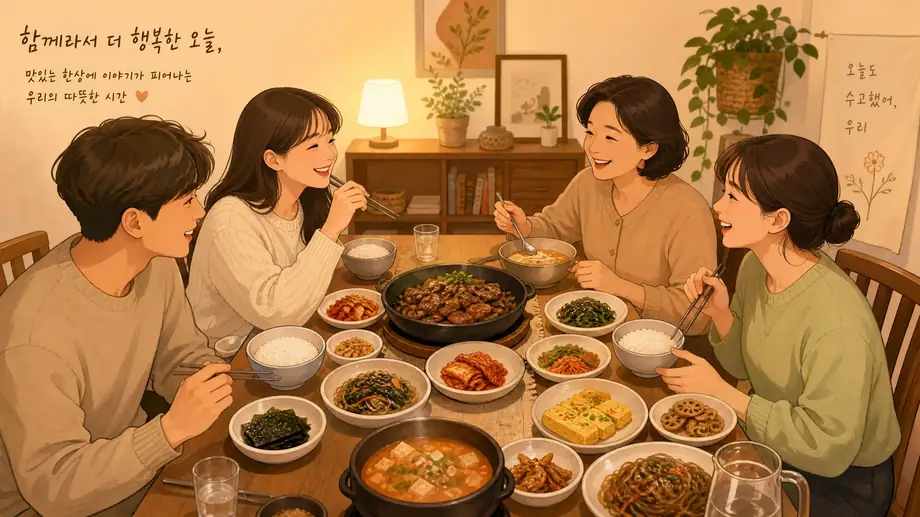
A colleague from Germany once told me he found it strange that Koreans ask "밥 먹었어요?" (Have you eaten?) as a greeting. "Why does it matter if I've eaten?" he asked, genuinely puzzled.
I had to think about it. I'd said that phrase hundreds of times without ever questioning it. The answer, I realized, is that in Korean culture, making sure someone has eaten is one of the most direct expressions of care. It's not a question about food — it's a question about whether you're okay. Whether someone is looking after you. It maps onto "How are you?" but with a specificity that feels more grounded, more real.
After that conversation, I started noticing how much of Korean emotional expression runs through food. 잘 먹겠습니다 before a meal. 맛있게 드세요 when you serve someone. These aren't just polite phrases — they're a whole emotional vocabulary built around nourishment.
2. ⏩ 빨리빨리 Is a Feature, Not a Bug
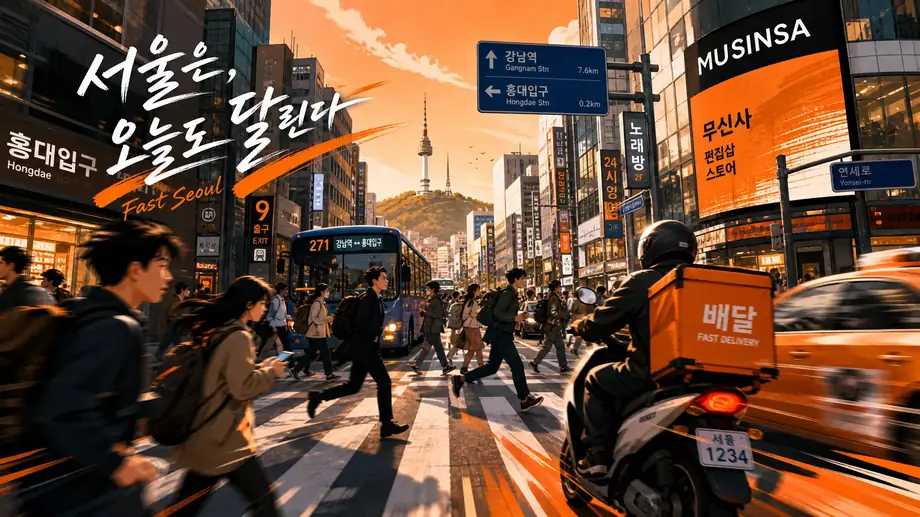
Every foreigner who's spent time in Korea has encountered 빨리빨리 (ppalli ppalli) — the Korean cultural tendency toward speed and urgency. Delivery in 30 minutes. Decisions made fast. Impatience with slow processes.
From the outside, it can look like impatience or lack of care. But working in international teams gave me a different perspective: 빨리빨리 is a cultural expression of respect for other people's time. The assumption is that if something can be done now, doing it later is a kind of inconsiderateness. It's not carelessness — it's a different relationship with time and efficiency.
My foreign colleagues who struggled with Korean work culture often found 빨리빨리 stressful. The ones who thrived reframed it: this is a culture that values execution and momentum. Once you understand the value behind the behavior, it stops feeling like pressure and starts feeling like energy.
3. 🎂 Age Is a Social Architecture
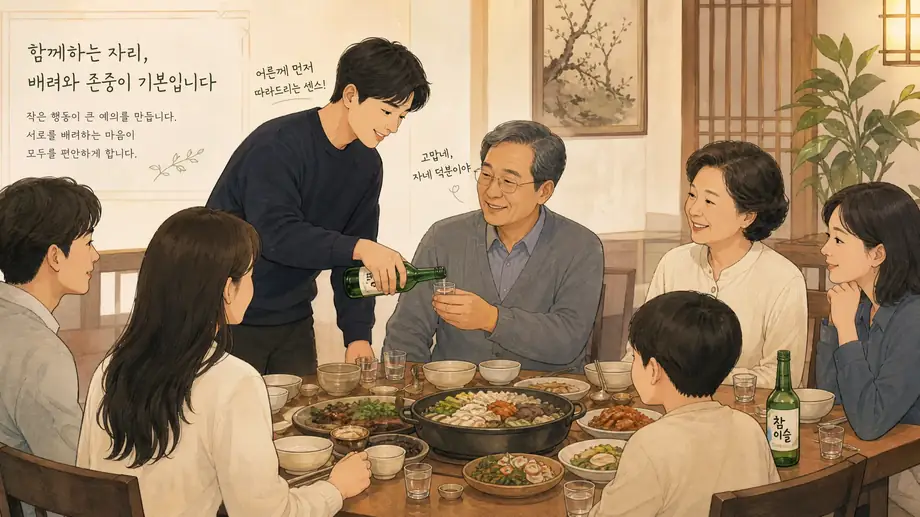
Nothing confused my foreign colleagues more than Korean age. The traditional system (everyone is born at 1, gains a year on January 1st) was officially replaced by international age in South Korea in 2023 — but the cultural weight of age hasn't changed at all.
In Korea, age isn't just a number — it's a social coordinate. It determines speech levels, seating arrangements, who pays for dinner, who speaks first in a group. My foreign colleagues sometimes found this hierarchy rigid. But I came to see it differently: it's a system that removes ambiguity. Everyone knows where they stand. There's a kind of social efficiency in that, even if it takes getting used to.
💡 Rian's Note — Why This Matters for Korean Learners
If you're learning Korean, understanding the age-based speech level system isn't optional — it's foundational. The reason Korean has 존댓말 (formal speech) and 반말 (informal speech) isn't arbitrary. It's a linguistic reflection of a social system. Learn the culture, and the grammar starts to make sense.
4. 🤝 Indirect Communication Is a Skill
In my experience working across cultures, the biggest source of miscommunication between Koreans and Westerners isn't language — it's directness. Korean communication tends to be high-context: a lot is implied, not stated. "It might be a bit difficult" often means "no." Silence after a proposal often means "I disagree but don't want to say so directly."
This isn't evasiveness — it's a different communication philosophy, one that prioritizes preserving relationships and face over blunt efficiency. Once I understood this, I became a much more effective communicator in both directions: I learned to be more direct with foreign colleagues, and I learned to help them read between the lines with Korean ones.
5. 👁️ 눈치 — Knowing Without Being Told

눈치 (nunchi) is one of those Korean concepts that doesn't translate cleanly into English — and that gap itself tells you something. It refers to the ability to read a situation, pick up on unspoken cues, and respond appropriately without being explicitly told what's needed.
In a work context, it might look like this: the team dinner is wrapping up, the senior person hasn't left yet, but you can feel the energy shifting — people are tired, it's getting late. Someone with good 눈치 quietly starts gathering their things, giving the senior person a natural opening to end the evening. Nobody said anything. Nobody had to.
My foreign colleagues often found this exhausting at first — "Why can't people just say what they mean?" But over time, the ones who stayed in Korea long enough started to appreciate it. There's something elegant about a culture where social awareness is considered a skill worth developing, not a workaround for poor communication.
💡 Rian's Note
눈치 없다 (no nunchi) is actually a mild insult in Korean — it means someone is socially oblivious. 눈치 빠르다 (quick nunchi) is a compliment. The fact that Korean has dedicated vocabulary for this — and English doesn't — reflects what each culture considers a social virtue.
6. 🤲 우리 — "We" as a Default
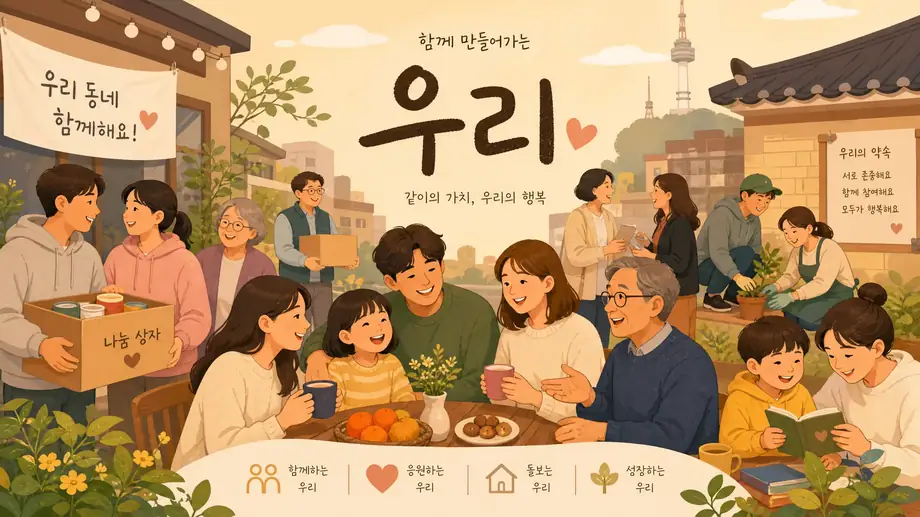
One of the first things that confuses Korean learners — and one of the last things native speakers notice — is the Korean habit of saying 우리 (we/our) where English would say "my." 우리 엄마 (our mom), 우리 집 (our house), 우리 나라 (our country). Even when you're talking about something that's clearly just yours.
A colleague once asked me, genuinely confused: "You said 우리 엄마 — do you share a mom with someone?" I laughed, but it made me realize how deeply this pattern is embedded. In Korean, ownership is often framed as belonging — not "my mom" but "the mom I belong to." Not "my house" but "the house we share."
This isn't just a grammar quirk. It reflects a cultural orientation toward collective identity — the idea that you exist in relation to others, not just as an individual. After years of working in more individualistic cultures, coming back to this felt both familiar and newly meaningful. It's a small word, but it carries a whole worldview. 🌙